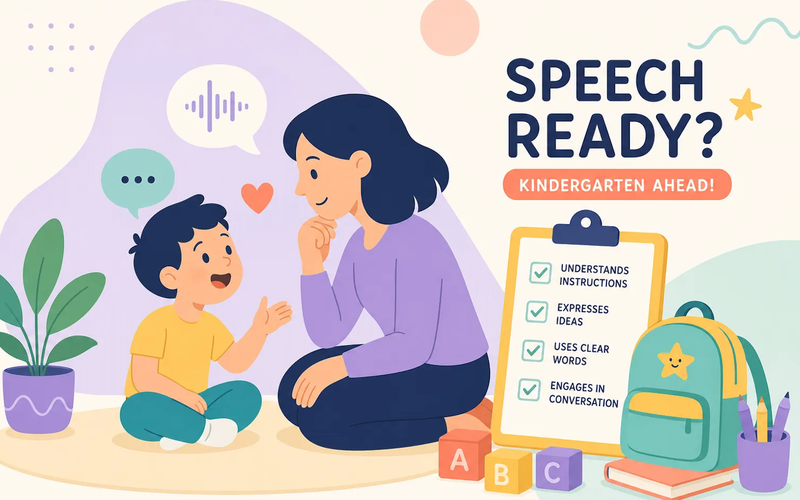
Is my child ready for kindergarten, speech-wise? Kindergarten registration has a way of making parents ask exactly that. You're too busy loving your child day to day, and then suddenly you notice things. The way the "r" still sounds mushy. The fact that the neighbor's kid tells longer stories. A quiet worry that settles in and asks, are we okay?
That worry isn't panic. It's awareness. And awareness at this stage, when your child still has months before the first day of school, is genuinely one of the most useful things you can have. At Speech Language Screening California, the question we hear most from families this time of year is exactly that: is my child ready for kindergarten speech-wise? It's a fair question, and it deserves a real answer, not a vague "every child develops differently" that leaves you no better off than before.
This article gives you a practical, honest look at what kindergarten speech readiness actually involves, which warning signs are worth taking seriously, what you can do at home right now, and what to do if a gap shows up when you go through the checklist.
Speech Skills Expected by Age 5
Think of this section as your starting point, not a pass/fail test. Developmental benchmarks exist on a range, and most children land somewhere inside that range without checking every single box perfectly. Still, there's a clear picture of what teachers are working with on day one, and it helps to know what that picture looks like.
Clear Speech: How well can strangers understand your child?
Speech intelligibility norms shift between ages 4 and 5. Around age 4, unfamiliar listeners typically understand about 50 percent of what a child says; by age 5, that figure rises to roughly 75 percent. A practical way to check this: if a neighbor, a checkout clerk, or a new friend's parent can follow your child's conversation without asking you to translate, that's a solid sign. A few later-developing sounds like "r," "l," and "th" are still maturing at this age and aren't automatic red flags on their own. What matters is whether the overall message comes through clearly most of the time.
Sentence length, grammar, and questions
Five-year-olds typically speak in sentences of five to six words or more, use grammatically complete sentences most of the time, and can both ask and answer "who," "what," "where," and "why" questions. One meaningful marker of language complexity that often goes unnoticed: using connecting words like "because," "so," and "but." A child who can say "I don't want to go because I'm tired" is showing you something important about how their language is developing, not just what they're feeling.
Vocabulary, categories, and time concepts
Children entering kindergarten are expected to know basic categories like animals, food, and clothing. They should also understand location words such as "behind," "beside," and "between," and time concepts like "yesterday" and "tomorrow." These aren't bonus skills; they're building blocks teachers assume are already in place from the first week of school.
Communication Skills That Often Get Overlooked
Many parents notice pronunciation first, which makes sense because speech sounds are the most visible part of language development. But two other skills matter just as much for kindergarten speech readiness, and schools assess both.
Following multi-step directions without visual cues
By age 5, a child should be able to follow two- to three-step directions without needing gestures, demonstrations, or repeated prompts. Try this at home: say "Go to your room, get your shoes, and bring them here," then wait. If your child can carry out all three steps without a visual assist, that's a strong sign. This skill matters enormously in a classroom, where instructions are multi-step from the very first day.
Storytelling, retelling, and conversational back-and-forth
Kindergarten-ready children can retell a familiar story or describe a recent event in a logical order, hitting at least two or three key details along the way. They can also sustain a real conversation: not just answering your questions, but asking their own and staying on topic across several exchanges. Narrative skill is one of the strongest early predictors of reading success.
Red Flags to Watch
Some things genuinely are fine and will resolve on their own. But some things won't, and the difference matters. Here's what actually warrants a closer look.
Speech clarity and sound production warning signs
By age 4, speech that is still unclear to people outside the family is a referral-worthy concern, not a "wait and see" situation. Specific patterns to watch: very limited consonant variety, vowel distortions, or speech that even close family members struggle to follow consistently. If your child had words or sounds and then lost them, call a professional right away, at any age. Regression is never something to wait out.
Language, comprehension, and social communication concerns
Difficulty following simple one-step directions, a vocabulary that seems noticeably smaller than same-age peers, and limited sentence use by ages 4 to 5 are all worth flagging. On the social communication side, watch for limited back-and-forth exchange, rare use of gestures or facial expressions, or a child who seems disconnected during conversation rather than engaged with it.
Home activities that actually move the needle (in under 10 minutes a day)
Preschool language research consistently shows that short, frequent, interactive practice beats longer occasional sessions. Five to ten minutes daily, done consistently, outperforms a weekend marathon.
Shared reading and everyday conversation routines
Dialogic reading is one of the most well-researched tools for vocabulary and language growth in this age group. The technique is simple: pause during a book, ask open-ended questions, let your child fill in words, and gently expand their short responses into slightly longer ones. If your child says "dog runs," you say "yes, the big brown dog runs fast."
Games that build directions, vocabulary, and storytelling
Simon Says and simple barrier games build multi-step direction-following in a low-stakes, playful way. Sound scavenger hunts and mystery bag games target articulation and descriptive vocabulary without feeling like drills. Pretend play scenarios — a restaurant, a doctor's office, a play kitchen — build sentence length, social language, and narrative structure all at once.
What to do if your child doesn't check all the boxes
Finding a gap in the checklist doesn't require a dramatic response. It requires a clear next step. And the clearest next step, before the school year starts, is a professional screening.
Why getting a screening before school starts is worth it
School-based speech evaluations can take weeks or months to initiate after a concern is flagged, and by then the school year is already in motion. A clinical-grade screening done before kindergarten gives you a written picture of where your child actually stands right now, along with a concrete set of next steps.
How a telehealth speech screening works
Speech Language Screening California offers a 30- to 45-minute secure video session with an ASHA-certified, licensed speech-language pathologist, bookable online with no waitlist and no commute. A written screening report with findings and next-step recommendations arrives within 48 hours. The service is available to families across California, including Sacramento, the Bay Area, the Central Valley, and Los Angeles.
Articulation Milestone Chart
Understanding the typical development of speech sounds can help you gauge whether your child's pronunciation is progressing as expected. An articulation milestone chart outlines the key sounds children generally acquire by certain ages. For example, by age 4, most children can accurately produce sounds like "m," "b," and "d," while more complex sounds like "r," "s," and "l" are usually mastered closer to age 5. Monitoring these milestones can give you additional insight into your child's speech development and help determine if professional guidance is needed. You can find the milestone chart our speech milestones page.
Your child has more time than you think — but not unlimited time. If any of the red flags in this article resonated, a telehealth screening with Speech Language Screening California is one of the clearest ways to get a professional picture before kindergarten starts. You don't need a referral, you don't need to wait months, and you don't need to wonder.